


ai chat
Designing AI chat that moves customers forward
Transforming a fragmented support channel into an AI-first experience that created more customer contacts, increased appointment conversion and reduced pressure on brokers.
Aussie & Lendi / Web & mobile / 2024
From hidden support tool
to an always-available conversation.
- Discover chat
- Ask without login
- Understand intent
- Connect with a broker
Reported project outcomes. pp means percentage points.
01 / The opportunity
People were arriving. Conversations were not starting.
In early 2024, thousands of people visited the Aussie and Lendi websites each week, but relatively few progressed into chat or booked an appointment. A channel intended to help was difficult to discover, available only during business hours and gated behind login or account creation.
Even when a customer reached an agent, repeated qualification questions and inconsistent tone could add friction. After-hours visitors had nowhere to go. The opportunity was to make chat a useful first step in the home loan journey, with a clear route to a broker when needed.
02 / My role
I connected the research, the interface and the conversation.
I led the redesign of the group’s digital chat experience across Aussie and Lendi, from discovery through conversation design and interface execution. I used product analytics, session playbacks and chat-team insights to understand where the experience was breaking down.
My work included the AI agent persona, shaping and training its behaviour, the conversational flows, and the UI components and entry points. The aim was a shared system that could support both brands while making the customer’s next step easier.
03 / Discovery
The first barrier appeared before the first message.
I combined product analytics in Amplitude with behavioural observation, chat-agent interviews and competitive research. We analysed more than 2,000 chat sessions and tracked four key funnels, looking at discovery, drop-off, time of day and progression from chat to contact and appointment.
Only around 10% of visitors discovered the chat widget on key pages. At the login wall, 60% dropped off before receiving assistance. Meanwhile, 40% of chat attempts happened outside business hours, when no staff were available. Mobile-initiated sessions converted 25% better than desktop in the analysis, pointing to the importance of visibility and context.
To understand the behaviour behind those numbers, I observed 12 recorded sessions and interviewed three chat agents over a week of analysis. People hesitated around chat triggers, backtracked at login and left during long pauses. Friendlier openers were associated with longer engagement, while agents described repeating basic qualification questions.
The competitive review covered mortgage services, banking chatbots and established messaging products. It helped identify useful patterns for discoverability, warm language, structured qualification and human escalation. Together, the research made the priorities clear: make chat visible, remove the login barrier and shorten the wait for useful help.
- Chat sessions analysed
- 2,000+
- Discovered chat on key pages
- ≈10%
- Dropped off at the login barrier
- 60%
- Chat attempts outside business hours
- 40%
04 / Test the premise
Before building the conversation, test the invitation.
Our hypothesis was simple: if we surfaced chat earlier and removed friction, more people would engage, creating more opportunities for contacts and appointments.
We tested demand with a floating chat button on high-intent pages. Clicking it displayed a “coming soon” message. This small fake-door experiment let us evaluate the entry point before investing in the full experience.
The visible button outperformed the hidden entry point. People clicked even though chat was not yet available, with stronger engagement on mobile and a clear relationship to high-intent browsing. That supported the direction, while keeping the limits of the test clear: it demonstrated interest in starting chat, not the quality of a finished conversation.
05 / Design approach
An easy opening. A useful answer. A clear next step.
The strategy brought the findings into a coherent experience: visible entry points, a first interaction without login, 24/7 AI-led triage, warm and transparent language, and reliable routing for refinance, pre-approval and appointments.
I designed five connected layers, from how someone discovered chat to how their context reached a broker. A controlled knowledge library and compliance-reviewed responses supported consistency. The tone layer helped the experience feel clear and approachable across both brands.
AI handled repetitive early questions and gathered useful context. Human escalation remained part of the service for more complex needs. The quality of that transition mattered as much as the answer within the chat itself.
- 01
Entry
A floating chat button, page-level triggers and contextual placements make help easier to find.
- 02
Intent
Structured pathways recognise pre-approval, refinance, appointments and general enquiries.
- 03
Knowledge
A controlled, compliance-reviewed content library supports consistent responses.
- 04
Tone
Warm, human-centred language creates a coherent experience across Aussie and Lendi.
- 05
Handover
Brokers receive the conversation context when a customer needs human support.
06 / Controlled rollout
Earn confidence before increasing reach.
After the entry-point experiment, we released AI chat to 10% of traffic during working hours. This gave us a controlled setting to observe tone, intent handling, escalation and operational impact before scaling.
The rollout showed that AI could handle repetitive early-stage questions, and that warm, clear responses helped people continue. Escalations worked better when the AI gathered key details first, reducing the work brokers had to repeat. The shared architecture also performed consistently across both brands.
Over the quarter, traffic increased as confidence grew and the system stabilised. We expanded to 24/7 AI triage, deepened intent pathways and used live conversation data to refine tone, routing and pacing. Availability was a service decision supported by testing, rather than simply switching on a chatbot.
- Visible entry-point test
- 10% of traffic · working hours
- Observe and refine
- Expand across the quarter
- 24/7 AI triage
Try the live product
Experience Aussie Chat for yourself.
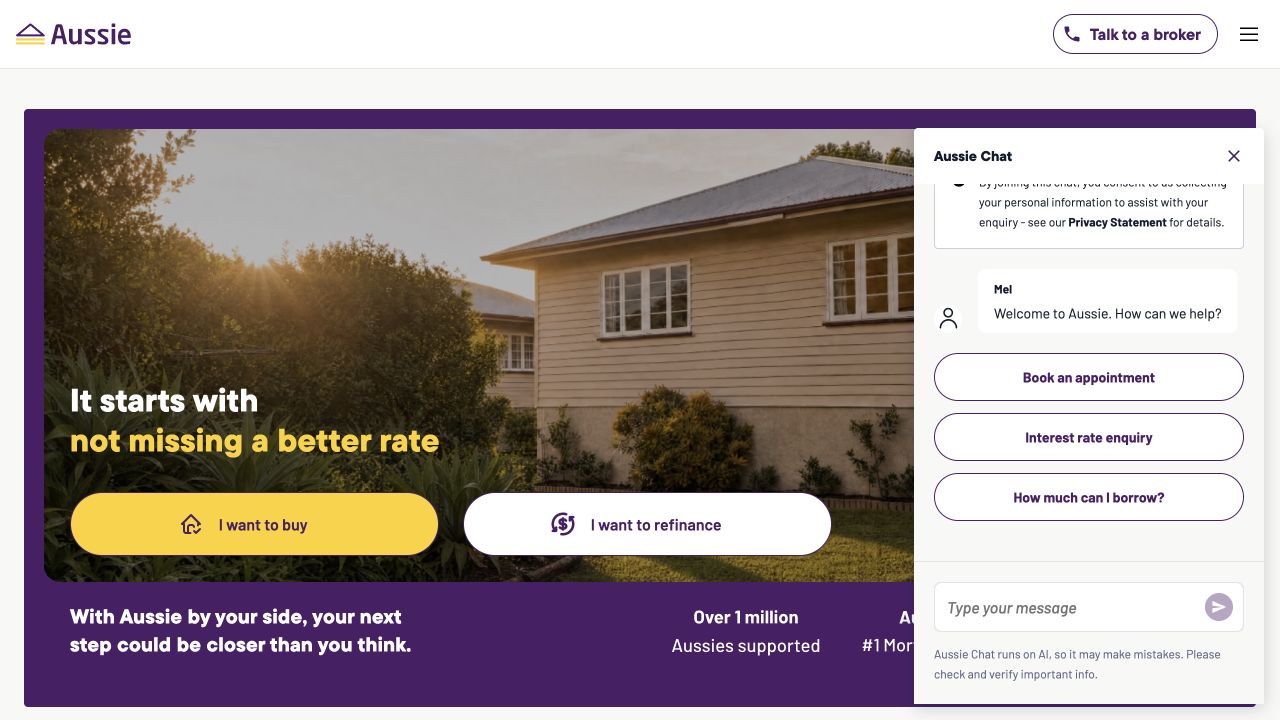
Open the current product on Aussie’s website and explore how it welcomes a question, offers starting points and guides the conversation.
- 01
Open Aussie’s website in a new tab.
- 02
Select the chat bubble labelled “Got a question? Chat with an expert.”
- 03
Choose a topic or type a question to explore the current experience.
Opens Aussie in a new tab. Conversations happen on Aussie’s website under its privacy terms. ChatPNT is the separate portfolio guide.
07 / Impact
More useful conversations. Less repeated work.
The project reported a five-percentage-point improvement in chat-to-contact creation, from 28% to 33%, and a 25% increase in chat-to-appointment conversion. Call volume fell by 30%, and broker handling time fell by 31%.
The operational changes helped explain those results. AI took on repetitive qualification, intent routing reduced misdirected enquiries, and brokers received better context. Round-the-clock triage also captured demand that had previously arrived when the team was unavailable.
These figures describe the outcomes reported in the case study. The 25% appointment result is a percentage increase, while the contact-creation result is a percentage-point change. They measure progression through the service, not completed loans.
08 / Reflection
The AI mattered. So did everything around it.
The strongest lesson was that making a conversation easy to start can change both engagement and conversion. Better entry points, fewer barriers and a warm, honest tone were essential parts of the AI experience.
Small experiments helped establish direction before larger builds. Working with compliance early and designing the conversation architecture as a system supported a more consistent rollout across both brands.
The next opportunities identified were continuous feedback on routing and tone, a broader library for complex lending scenarios, and a shared AI interaction playbook. The system also created a foundation for extending conversational support into voice, SMS and other customer touchpoints.