


Aussie / Contract Analyser
Contracts without the confusion
Building a confidence engine for Australian property buyers. Turning contracts of sale, sometimes more than 1,000 pages, into a plain-English analysis of key terms, potential red flags and better next questions.
01 / My role
From customer uncertainty to a product people could trust.
I led the customer research and strategic framing, defined the trust model and product boundary, validated the product name, and used a broker and internal-team pilot to refine the AI prompts, UI and end-to-end experience before wider release.
The people behind the work
Product and engineering turned broad research into a focused experience. AI and data converted trust concerns into requirements for transparent, repeatable outputs. Legal and conveyancing shaped a useful first pass without presenting it as professional advice. Brokers positioned the analysis as shared context for a better conversation. Business stakeholders connected engagement to acquisition, repeat use and downstream services.
02 / The opportunity
Buyers had plenty of information. They still didn’t know what mattered.
Every weekend, Australians leave open homes with one of the most difficult parts of the property journey: the contract of sale. Buyers must interpret unfamiliar language, identify what deserves attention and decide what to do next, often under significant time pressure.
All 70 research participants already used a major property portal. Many supplemented it with search, comparable sales, family, brokers and AI. Their workaround was a patchwork of sources they had to reconcile themselves.
- Wanted help deciding whether to act
- 48/70
- Wanted risks and red flags identified
- 41/70
- Wanted easier property comparison
- 39/70
- Felt very confident making that judgement
- 6/70
“Show me the important information.”
What customers were already doing
100% used a major property portal. 60% used Google research. 49% researched comparable sales. 43% sought advice from family or friends. Customers were asking for evidence-led support that reduced uncertainty while respecting their judgement.
03 / The reframing
Confidence was the product. Analysis was the mechanism.
From “summarise a document” to “help buyers decide what deserves attention”. The customer value was safe confidence: confidence grounded in visible evidence and acknowledged uncertainty.
“The product does not make the decision for buyers. It makes the decision easier to understand.”
04 / The trust boundary
Trust had to be part of the interaction.
The product needed to sit between a raw document dump and implied legal advice. Explain what may deserve attention, show why, and help the customer ask a better next question.
Comparable evidence built trust for 45 participants. Disclosing missing information mattered to 39, explaining confidence to 38, and showing sources to 36.
Generic answers, hidden assumptions, inconsistent results, valuation-like framing and confident language without explanation damaged trust.
- Raw contract
- AI analysis
- Evidence-led guidance
- Better questions
- Broker / conveyancer
“I worry it sounds confident when it shouldn’t.”
More voices from the research
“Show where the information comes from.” “I would worry it is really a valuation in disguise.” The boundary was evidence-led guidance and better questions, rather than legal advice, a valuation or a recommendation to buy.
05 / Naming the promise
Even the name had to earn trust.
200 participants. Four survey waves. Names were evaluated for trust, likelihood to choose, distinctiveness, appropriateness and expectation-setting.
Contract Analyser consistently ranked first because it clearly described the function, felt professional and signalled a first-pass analysis rather than formal advice.
“It sounds the most professional and clear about what it does.”
Naming research and deliberate trade-offs
The ranked names were Contract Analyser, Contract Wise, Contract Explainer, Contract Summariser and Contract Buddy. Contract Buddy was more distinctive, but less credible for a legal decision. In a high-stakes category, credibility mattered more than creativity.
We chose a focused contract tool over broad property intelligence, explained uncertainty over short definitive answers, staged rollout over immediate wide release, and behavioural validation over concept ratings alone.
06 / Pilot before scale
We learned with real contracts before opening the doors.
The first release went to brokers and internal teams. This controlled pilot let us refine interpretation, structure and calibrated uncertainty in the prompts; hierarchy, status communication and file controls in the UI; and expectations, the email return path and access to results across the journey.
Real contract use → feedback → prompt and UI refinement → specialist review → wider release.
07 / The solution
A short journey for a high-stakes task.
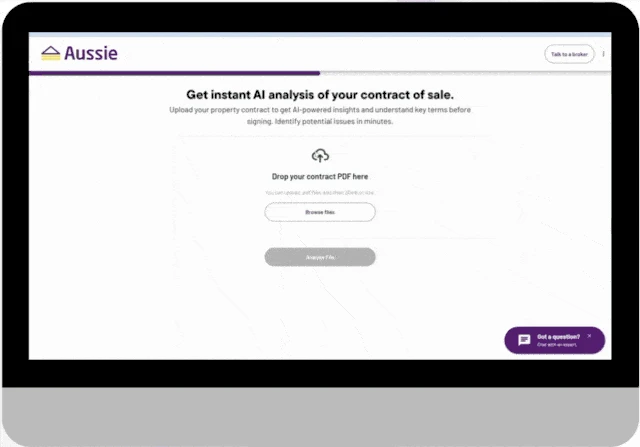
The experience deliberately asks the customer to do very little. The complexity sits behind the interface.
- 01
Upload with control
Upload the contract directly, with clear confirmation and replace/delete controls.
- 02
Set expectations
Analysis usually takes under two minutes. Completion confirmation and an email link provide a reliable return path.
- 03
Understand
Read a plain-English analysis of key terms, potential red flags and questions worth asking next.
- 04
Take it with you
View, download or print the result. Upload another contract, share the context with a broker, or seek professional review.
“The interface stays simple because the difficult work should happen in the analysis, not in learning the product.”
08 / Shared context
The analysis became a better conversation.
Customers and brokers can work from shared information, with a pathway to Aussie Conveyancing when full professional review or settlement support is needed.
Contract upload → clearer understanding → better broker conversation → professional support → settlement.
09 / Outcomes
The strongest signal came after the first upload.
40% of users uploaded multiple contracts. This repeat-use signal suggests buyers were using the analyser across an active property search, beyond a one-off document task.
Brokers and customers adopted the analyser soon after release. New customers also discovered Aussie through the tool. Usage increased around open homes, when contracts entered the journey and decision pressure was highest.
For buyers: less effort understanding a contract and clearer questions. For brokers: shared context and a better-prepared customer. For Aussie: earlier acquisition, repeat engagement and a pathway into conveyancing.
How commercial impact will be measured
Acquisition: new analyser users who become qualified broker leads. Conversion: uplift in broker conversations and funded loans. Conveyancing: eligible analyses that become retained matters. Retention: downstream conversion differences between one-time and repeat users. Efficiency: reduced repetitive explanation for brokers and support teams.
Financial ROI will be calculated from observed funnel data rather than inferred from upload volume alone. These are future measures, not reported outcomes.
10 / Reflection
Confidence, not summarisation, was the real product.
The valuable outcome was helping customers decide what deserved attention. A shorter document was never the end goal.
Explainability had to be designed into the experience. Evidence, missing information and calibrated language were core interactions.
Realistic use showed that prompt behaviour and interface design could not be refined independently. The pilot improved the model and UI together.
“We turned a document people dread opening into a conversation they feel ready to have.”